

The writer’s first near view of the volcano after the eruption of this year was on the afternoon of April 24, when he took his way toward Dr Matteuci’s observatory. The electric train was pushing slowly with its cogged wheels upward toward the observatory station; beyond that point the road was destroyed. The fields outside of Naples showed one or two inches of dust, brown, gray, and gray-green, but most of the vegetable gardens had been cleared of it. A little farther the pines as in a snowstorm. It was three inches deep on the walls. It had drifted in places to a depth of two or three feet. On nearing the observatory the lava fields of 1872 and 1898 were found buried under 5 or 6 inches of sand and dust, which formed a heavy mantle, but not sufficient to wholly disguise the slaggy contortions beneath. The whole cone of Vesuvius became cleared of clouds in the course of the afternoon and it was seen to be covered with straight sand slides of whitish-gray color which occasionally slipped downward as on the steeper slopes of a dune.
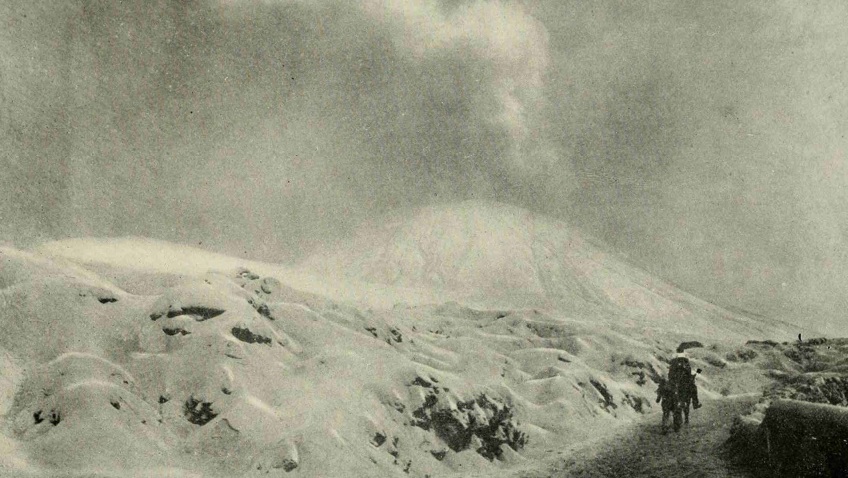
Vesuvius dal The National Geographic Magazine del 1910 – L’eruzione del 1906 – vesuvioweb 2016.pub
